
Running a Sex Offender Check in Coffee County
The official starting point is the Georgia Sex Offender Registry, published by the Georgia Bureau of Investigation. It can be filtered to Coffee County and viewed as a list or map. A name, Offender ID, city, ZIP code, street address, or county can narrow the results. No one field is always best: a name is useful for a known person, while an address and radius are better for place-based awareness.
The Coffee County Sheriff is the local registration authority. It receives registrations and changes from people who reside in Coffee County, verifies information as Georgia law requires, and forwards updates to GBI for statewide publication. Questions about suspected noncompliance or a local address should go to the sheriff rather than to a person shown in a result. The registry is a public notification record, not a complete account of every court event or arrest.
Why Coffee County Registry Searches Start With a Warning
The GBI landing screen requires a visitor to choose “I agree” or “I do not agree” before reaching Coffee County results. That step matters. GBI states that the database is continuously updated, that its information comes from other agencies, and that addresses and status details can change often. It gives no express or implied guarantee that every item is accurate at the moment of a search.
The official registry screen shows that agreement before its search controls.
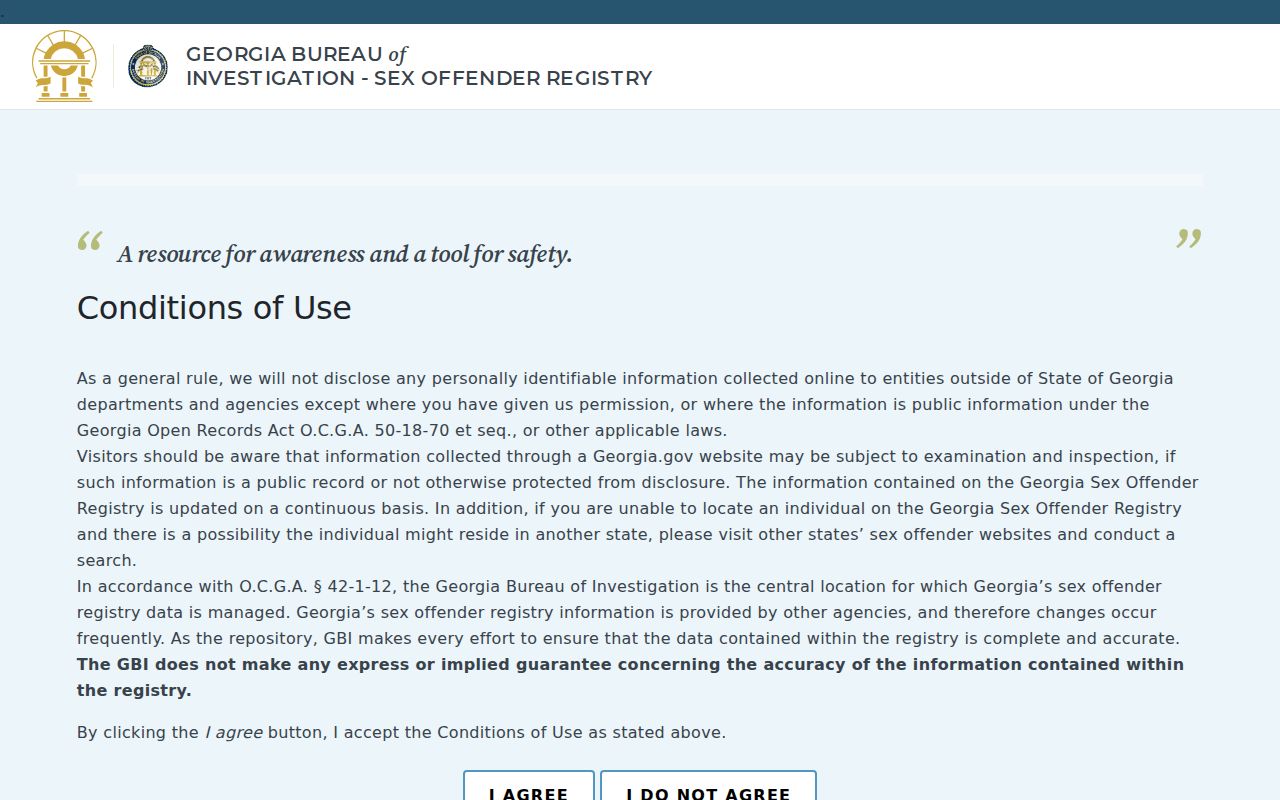
The screen reinforces why a result is a current public lead that still may need confirmation. An empty Coffee County search does not prove that no registration duty exists. A person may have moved, may be registered in another Georgia county, or may appear in another state. A recent update can also be moving through the local-to-state reporting chain.
Searching the Georgia Sex Offender Registry
GBI operates the statewide search and supplies several ways to reach Coffee County records. Begin with the least amount of information that answers the question, then add filters if the list is too broad. Spelling, aliases, city boundaries, and recent moves can affect what appears, so repeat a search with another control when the first try is inconclusive.
- Open the official GBI registry, read the accuracy and lawful-use notice, and select “I agree” to continue.
- Enter a name or Offender ID, or choose Coffee County, city, ZIP code, street address, and radius for a place search.
- Run the search, switch between map and list views where available, and compare identifying fields without relying on a photograph alone.
- Open the profile, note its status and registration county, then contact the proper agency if an address or compliance detail needs confirmation.
| Field Label | Type | Required | Notes |
|---|---|---|---|
| First and Last Name | Text | No | Use for a known person; try aliases or fewer fields if needed. |
| Offender ID | Text | No | Targets a known Georgia registry identifier. |
| Offense, Gender, Race | Filter | No | Optional controls that narrow a broad result set. |
| County, City, ZIP Code | Select/Text | No | Select Coffee for a countywide view or use a smaller locality. |
| Street Address and Radius | Text/Select | No | Supports a proximity search around a specific place. |
| Map and List | View | No | Changes presentation, not the source record. |
Name, Address, or Coffee County Registry Search
Each search method answers a different question. A name check is direct when identity is known, but common names and spelling differences can cause doubt. The Coffee County filter offers a broad local sweep. City and ZIP filters narrow the area, though postal boundaries do not always match city limits. An address-radius search centers awareness on a home, school route, park, or other place without assuming all nearby addresses share one ZIP.
Use more than one route when the issue concerns personal safety. Start broad, then compare the registry identifier, aliases, physical description, and address information on the profile. Do not treat one mismatch as proof that two records concern different people. Only an official agency can resolve a disputed identity or status.
What a Coffee County Registry Profile Shows
A public profile groups identifying, location, offense, and compliance information supplied through Georgia's registry system. Fields vary by record, and the page should be read as a whole. The offense summary is not a substitute for the filed Coffee County court case, and the public profile is not a full GCIC criminal-history report.
| Name & Aliases | Registered name, known aliases, Offender ID, and available age or birth information. |
|---|---|
| Photo & Physical Description | Current or prior photos plus sex, race, height, weight, hair, eyes, and reported scars, marks, or tattoos. |
| Registered Address | Primary, secondary, or temporary address information and the Georgia county responsible for registration. |
| Offense & Statute | Offense, statute, jurisdiction, and conviction date fields supplied for the qualifying matter. |
| Classification | Georgia status or risk markers, which should not be translated into generic federal tiers. |
| Other Details | Vehicles and other registration fields may appear when present in the source record. |
| Registration Status | Compliance or absconded indicators and other available public status information. |
Coffee County Sheriff's Registry Role
Local registration and statewide publication are two parts of one process. A person residing in Coffee County reports through the sheriff, and the sheriff forwards the relevant information to GBI. GBI then publishes the statewide registry. This explains why a Coffee County address question belongs first with the sheriff even though the public search carries GBI branding.
The Coffee County Sheriff operates at 825 Thompson Drive in Douglas and can be reached at 912-384-4227. That contact is appropriate for suspected failure to register or for a local detail that appears stale. Give the agency the public profile URL or Offender ID and describe the issue. Do not confront, follow, threaten, or photograph a private household.
Registration Requirements and Levels in Georgia
Georgia does not use a generic federal Tier I, II, and III chart for public interpretation. O.C.G.A. §§ 42-1-12 and 42-1-14 govern registration and state risk classification. Lifetime registration is common, but duration and possible removal depend on the conviction date, offense category, classification, and statutory petition rules. A public Coffee County profile alone cannot establish the final end date of a person's duty.
| Georgia Classification | Duration | Public Meaning |
|---|---|---|
| Level I | Case-specific; lifetime registration is common | A Georgia risk class, not a generic federal duration tier. |
| Level II | Case-specific; lifetime registration is common | A higher state risk class that must be read under Georgia law. |
| Sexually Dangerous Predator | Case-specific statutory duty | A distinct Georgia classification with requirements set by state law. |
| Not Yet Classified or Other Status | Depends on offense, date, and legal history | Absence of a level does not itself define duration or duty. |
The sheriff verifies local registration according to the duty that applies to the person. Frequency should not be guessed from a federal chart. For a specific Coffee County record, use its profile, the controlling Georgia statute, and an official agency response.
If Coffee County Registry Data Looks Out of Date
A recent move, new registration, agency correction, or change in status can create lag even in a database updated each day. Preserve the profile URL, note the Offender ID and the field that appears wrong, and contact the Coffee County Sheriff or GBI. State the concern without publishing personal details elsewhere.
If the search may cross a state line, use the National Sex Offender Public Website. NSOPW routes searches across participating jurisdictions, but each source still controls its own definitions and updates. Return to the registering state or local agency for the most current detail. A Coffee County-only result cannot establish what another state holds.
Note: Daily updates reduce delay, but they do not erase the time needed for local agencies to report and correct information.
Registry Listing, Court File, and GCIC History
These three products answer different questions. A Coffee County registry listing describes a registration duty and public status. A Coffee Superior or State Court file documents filed charges, motions, pleas, disposition, and sentence in that case. A GCIC history links Georgia identification, fingerprint-supported arrests, reported dispositions, and custodial information. One cannot safely stand in for the other two.
When an offense label needs context, seek the originating court file rather than drawing a conclusion from the short registry line. When someone reviews their own statewide history, use the official GBI process. The broader Coffee County criminal history overview explains how county and state channels divide those records.
Lawful Use of Coffee County Registry Information
The registry exists for public awareness and safety planning. It can help a Coffee County resident understand a nearby listing, identify the registering agency, and decide whether to ask an official question. It does not authorize a reader to take enforcement into private hands. GBI's conditions stress the limits of the data, and those limits matter when a status or location may have changed.
Misuse is unlawful: O.C.G.A. § 42-1-12 forbids using Georgia registry information to harass or intimidate a registrant. Never threaten, confront, or target a person or household; report safety or compliance concerns to law enforcement.
Keep any safety plan focused on lawful steps: verify the source, contact the Coffee County Sheriff when a local record appears wrong, and call emergency services only for an immediate threat. Registry publication is community notification, not a finding that a new offense has occurred.